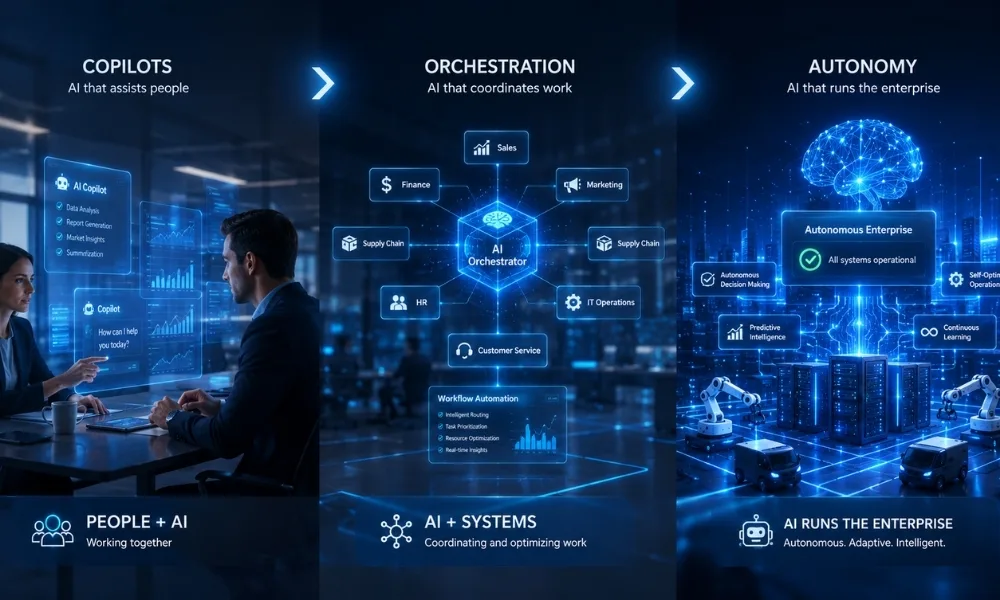
Artificial intelligence has rapidly evolved from a niche exploratory resource into a defining layer of the modern corporate technology stack. In the initial phases of adoption, organizations relied primarily on assisting tools digital helpers designed to supplement human operations. However, the overarching technological trajectory is shifting explicitly from Copilots to Autonomy, moving toward self-governing systems capable of real-time execution, contextual evaluation and programmatic decision-making.
To safely facilitate this major shift from Copilots to Autonomy, businesses must rebuild their core technical layouts. Transitioning into self-governing software requires far more than simply plugging into external third-party models, it demands an intricate, scalable framework.
For companies deploying these advanced systems, partnering with an expert provider like IT Works Solutions ensures the foundational databases and storage pipelines can successfully handle the high-throughput computing required by multi-agent networks.
The Strategic Shift: Moving From Copilots to Autonomy
To understand the immense structural changes required by modern businesses, we must trace how artificial intelligence operates within an enterprise ecosystem. The progression from Copilots to Autonomy represents a complete reassessment of how software interacts with corporate assets.
The evolution of enterprise AI follows a distinct path. It begins with passive copilots that require continuous human prompting for every single task. As the architecture matures, it transitions into agentic workflows capable of semi-autonomous task routing. The ultimate goal is true autonomy, where self-correcting, closed-loop systems handle complex workloads end-to-end without needing manual intervention.
While a basic assist tool operates entirely on human commands, a truly autonomous system actively monitors enterprise workflows, identifies problems and applies corrective code independently. This major shift from Copilots to Autonomy redefines the parameters of operational efficiency.
To keep these complex internal channels open, businesses require robust localized infrastructure, making specialized managed IT services Las Vegas highly critical for managing the high-speed data exchanges that keep your operations running smoothly.
Rebuilding the Core Framework for Agentic Workflows
Transitioning along the path of Copilots to Autonomy changes how data is routed through a network. Autonomous agents don’t wait for static inputs; they continually poll databases, check for security red flags and trigger automated scripts.
Engineering this type of closed-loop environment means having comprehensive, round-the-clock infrastructure tracking. Utilizing premium 24/7 IT support allows software developers to keep their underlying virtual machines, server clusters and software repositories optimized around the clock, removing systemic friction points before they can compound into costly system downtimes.
Infrastructure Scaling and Algorithmic Execution
Seamlessly scaling digital infrastructure is essential to sustain high-volume data demands and prevent system bottlenecks. By deploying cloud-native architectures, businesses ensure their backend can handle traffic spikes, maintaining the computing power required to fuel complex enterprise applications.
Simultaneously, optimized algorithmic execution translates this raw infrastructure power into lightning-fast processing speeds. Fine-tuning algorithms to minimize latency allows systems to process real-time workflows instantly, maximizing operational efficiency and driving smarter, data-driven decisions at massive scale.
Mastering Core Architectural Layouts
To transition smoothly from Copilots to Autonomy, engineering departments must implement layered infrastructure changes. Managing decentralized artificial intelligence models demands deep resource tiering to ensure system availability.
Multi-Agent Orchestration Nodes
At this deep execution layer, autonomous agents need dedicated data coordination pipelines to communicate with one another without system freezing. Processing high-frequency computational loads means establishing micro-clusters that dynamically scale processing capability based on real-time algorithm requirements.
When infrastructure scales up to handle heavy loops, relying on experienced engineering support from IT Works Solutions provides the foundational safety net required to avoid unexpected data corruption.
Real-Time Telemetry and Infrastructure Balancing
To maintain systemic health, data teams must log all agent communication channels continuously. This level of granular telemetry tracking alerts systems to resource bottlenecks instantly, allowing automated loops to balance processing requests cleanly across active servers.
Optimizing Machine Learning Pipelines
Beyond basic hardware scaling, enterprises moving from Copilots to Autonomy must fine-tune their internal software mechanics to reduce processing delays and avoid operational friction.
Integrating Historical Data Models with Next-Generation Infrastructure
As companies navigate the shift from Copilots to Autonomy, they must ensure their automated architectures can bridge the gap between traditional enterprise data processing and next-generation machine learning. For decades, traditional enterprise data management relied on structured, rule-based systems to organize workflows safely.
For example, large corporate platforms like Automatic Data Processing have historically standardized high-volume transactional records to ensure absolute financial compliance. In a modern autonomous setup, these massive data sets must feed directly into live machine learning pipelines without manual export steps.
Similarly, consider the intensive computational scaling required for complex 3D modeling and engineering environments. The massive Market capitalization of Autodesk, which reflects its successful cloud-delivered solutions, underscores the incredible value placed on software platforms that translate complex, resource-heavy workflows into cloud environments.
For an enterprise driving down the road from Copilots to Autonomy, building a highly efficient, highly integrated layout is directly tied to long-term market valuation.
Managing Enterprise Protection Environments
Managing enterprise protection environments requires a unified approach to safeguarding critical infrastructure and data. By integrating proactive threat detection, robust access controls and automated compliance monitoring, organizations can mitigate evolving risks. Continuous assessment ensures operational resilience, securing complex digital assets across the entire enterprise while maintaining business continuity.
Deploying Advanced Security Frameworks
Granting applications independent execution rights means businesses must implement rigorous security guardrails. Moving along the spectrum from Copilots to Autonomy demands a total overhaul of legacy security architecture.
Zero-Trust API Architecture
At this foundational security tier, every single automated request, script execution and database call must be rigorously authenticated. Autonomous agents cannot be granted blanket administrative privileges. Instead, they must operate under strict micro-segmentation rules.
Enforcing these precise digital boundaries requires deploying advanced cybersecurity protocols such as real-time threat containment, encrypted token exchanges and behavioral anomaly detection to block unauthorized data access.
Proactive Threat Isolation Protocols
When an automated agent displays anomalous behavior, system security must isolate that specific thread instantly. Proactive isolation shields the broader system from malicious prompt injections and unauthorized data deletion.
Continuous Operations Monitoring
Maintaining total defensive compliance requires specialized engineering visibility, which is why aligning with a trusted provider for 24/7 IT management near me is essential for stopping threat actors before they can disrupt live production environments.
Auditing and Network Sizing for Self-Governing Systems
Maintaining system stability across an autonomous architecture requires consistent health audits. Unlike static software, independent machine learning workflows can consume highly unpredictable amounts of bandwidth.
| Architecture Layer | Autonomous Performance Focus | Remedial Action |
| Data Ingestion | Minimize sub-millisecond pipeline latency | Scale real-time caching nodes |
| Model Routing | Maximize dynamic API load balancing | Deploy distributed vector clusters |
| System Logging | Enforce immutable, audit-ready telemetry | Standardize localized threat blocks |
To prevent heavy automated loops from choking your business’s day-to-day operations, having premier network support Las Vegas is non-negotiable. Strong localized network tracking keeps data pipelines moving cleanly from your main server racks straight into your cloud storage buckets without bottlenecking.
To safely fund these highly advanced backend developments, companies must build reliable digital pipelines to maximize outward business growth. Partnering with an expert digital marketing agency in Las Vegas provides companies with the necessary client acquisition engines to keep revenue scaling alongside technological innovation.
Balancing the internal expenses of moving from Copilots to Autonomy with predictable lead generation ensures long-term operational health.
Maximizing Growth and Digital Market Share
To maximize growth and digital market share, businesses must leverage robust, data-driven strategies and optimize user experiences. By continuously refining advanced SEO tactics and capturing emerging digital channels, brands can outpace aggressive competitors and secure long-term, scalable online authority.
Simultaneously, scaling targeted marketing efforts allows organizations to connect deeply with their core audience. By adapting fluidly to real-time customer analytics, companies can maximize conversion rates, sustain high engagement and drive continuous revenue growth across all digital platforms.
Executing Intent-Driven Growth Strategies
Building an incredibly advanced corporate setup provides a major competitive edge, but only if prospective enterprise clients can discover your capabilities. While transitioning from Copilots to Autonomy optimizes internal production, deploying a premier revenue-driven SEO blueprint ensures your brand commands search engine dominance.
Hyper-Targeted Enterprise Lead Generation
At this strategic level, marketing efforts must target search queries used by B2B decision-makers seeking system automation. Capturing these technical keywords enables software-focused firms to directly match their architectural breakthroughs with businesses actively seeking automated integration partners.
Consistently drawing in high-margin client contracts ensures your organization secures the regular funding necessary to drive continuous research and development.
Organic Click-Through Optimization
To convert impressions into active customer conversations, technical articles must maintain high visibility rankings. Optimizing your layout for search crawler visibility helps solidify long-term authoritative standing within competitive industries.
Localized Authority Scaling
For enterprises looking to dominate their direct regional markets, implementing a targeted local SEO service Las Vegas allows your teams to easily outrank regional competitors and secure prominent placement across regional searches.
Long-Term Governance in the Autonomous Era
Establishing a successful transition from Copilots to Autonomy is a continuous process of refinement. It requires cross-functional synergy between software developers, compliance experts and network engineers.
By combining the structural benefits of moving from Copilots to Autonomy with reliable advanced cybersecurity, comprehensive 24/7 IT support from a trusted ally like IT Works Solutions and a sustainable revenue-driven SEO strategy, your enterprise can safely lead the next wave of industrial automation.
Key FAQs: Evolution From Copilots to Autonomy
Q1: What does the phrase “Copilots to Autonomy” mean in enterprise tech?
It describes the ongoing shift from passive AI assistants that require human prompting (Copilots) to self-governing, independent software systems (Autonomy) capable of executing end-to-end business operations on their own.
Q2: How does advanced cybersecurity protect autonomous systems?
Autonomous networks execute tasks independently, which drastically expands an organization’s risk profile. Robust security protocols ensure that agent permissions are isolated, vector databases are fully encrypted and unauthorized API calls are instantly blocked.
Q3: Why does a business need 24/7 IT support when moving toward automation?
Independent agents operate continuously without human breaks. Having dedicated infrastructure tracking ensures that underlying server clusters, cloud environments and data pipelines remain perfectly balanced and functional at all times.
Q4: How do data tools like Automatic Data Processing connect to this shift?
Modern enterprise architecture requires that massive legacy data structures and transactional repositories integrate cleanly into live machine learning frameworks without manual export delays, changing how historical databases feed modern models.
Q5: How does revenue-driven SEO support internal AI developments?
Building an advanced autonomous architecture requires significant research and development capital. Deploying premium search engine optimization captures intent-driven corporate clients, providing the frontend profit required to scale deep technical innovations.
Conclusion
Successfully scaling an enterprise from Copilots to Autonomy requires balancing bold innovation with structural discipline. Upgrading your systems to handle self-correcting workflows helps eliminate operational latency, replacing rigid processes with dynamic machine learning execution.
When anchored by stable 24/7 IT management near me, infrastructure tracking from IT Works Solutions and the local marketplace visibility provided by a local SEO service Las Vegas, businesses can confidently deploy modern, independent software arrays.
Ultimately, pairing rigorous architecture governance with a sustainable business growth plan ensures your organization remains highly secure, deeply efficient and incredibly profitable as the industry accelerates from Copilots to Autonomy.