The digital landscape of 2026 has moved beyond simple chatbots. We are now entering the era of agentic workflows, where artificial intelligence doesn’t just provide answers it executes complex, multi-step projects. Instead of a single prompt leading to a single response, agentic workflows allow a system to reason, use tools and refine its own output until a specific business goal is achieved.
At IT Works Solutions, we specialize in moving businesses from “AI curiosity” to “AI action.” By implementing autonomous agents and multi-agent systems, we help organizations automate entire departments of work, moving from manual task management to a high-level oversight model.
The Architecture of Agentic Workflows
Unlike traditional automation, an agentic workflow is dynamic. It uses LLM-based planning to decide which steps to take next based on the results of the previous step. This creates a loop of continuous improvement and execution that mimics human project management.
Planning and Decomposition
The first step in any agentic workflow is understanding the objective. This requires the AI to look at a high-level goal and determine the necessary path to success.
Recursive Task Decomposition
For massive projects, agents use recursive task decomposition. This involves breaking a high-level goal (like “Prepare a quarterly tax report”) into dozens of smaller sub-tasks. By breaking things down, autonomous agents can focus on one piece of logic at a time, drastically reducing errors. This structured approach is a hallmark of the Managed IT Services in Las Vegas we provide, ensuring complex infrastructure changes are handled with granular precision.
Chain-of-Thought Prompting
To ensure the reasoning is sound, we implement chain-of-thought prompting. This technique requires the AI to “show its work,” documenting each logical step before taking action. This transparency is vital for auditing and security, as it allows human supervisors to follow the “thought process” of the autonomous agents and intervene if the logic deviates from business standards.
Taking Action via API Integration
An AI that can only talk is limited. To be truly effective, agentic workflows must be able to interact with your existing software stack. The transition from “Generative AI” to “Agentic AI” is defined by the ability to trigger real-world changes.
Tool Use and Function Calling
Through tool use (Function calling), an agent can “reach out” and interact with the digital world. It doesn’t just describe how to fix a database; it calls the specific function required to fix it. This turns the AI from a consultant into a digital employee.
Advanced API Integration
At IT Works Solutions, we build custom API integration layers that allow your agents to talk to your CRM, ERP and even local hardware. This connectivity is the backbone of our Business Network Support Las Vegas, allowing agents to reset routers or update security protocols autonomously based on real-time network health data.
Self-Correction Loops
One of the most powerful features of agentic workflows is the ability to fix mistakes. If a tool returns an error, the agent doesn’t just quit; it enters self-correction loops. It analyzes the failure, adjusts its LLM-based planning and tries a different approach. This level of resilience is why major corporations like Automatic Data Processing are moving toward agent-driven logic for high-volume data handling and payroll accuracy.
Human-Centric Design and Security
While the agents are powerful, they function best within a human-in-the-loop (HITL) framework. This ensures that a human expert provides the final “okay” for critical decisions or high-value transactions, maintaining accountability.
Cybersecurity Services Las Vegas
In the world of security, speed is everything. Our Cybersecurity Services Las Vegas utilize agentic workflows to hunt for threats 24/7.
- Autonomous Agents: These digital hunters perform recursive task decomposition to investigate millions of network packets simultaneously.
- Task Orchestration: When a threat is found, task orchestration ensures that the firewall is updated, the admin is notified and a remediation report is generated all in seconds.
Custom Websites & Software Development
When we engage in Custom Websites & Software Development, we build with agents in mind. We ensure your site has the proper documentation and structure so that the multi-agent systems of the future can navigate and interact with your brand seamlessly. This “Agent-Ready” development is essential for remaining competitive in an AI-driven economy.
Market Impact and SEO Strategy
The shift toward agentic workflows is visible in the market today. For example, the market capitalization of Autodesk sitting at approximately $50.2 billion in early 2026 highlights the massive value investors place on companies that are successfully integrating agentic design and AI-driven automation into their core engineering tools.
Strategic SEO for Local Businesses Las Vegas
Your SEO strategy must also adapt to the agentic era. Our Strategic SEO for Local Businesses Las Vegas focuses on “Agent Optimization.”
- Structuring for Search Agents: We optimize your data so that the autonomous agents used by consumers for AI-driven search can easily find and recommend your services.
- Topical Authority: By using chain-of-thought prompting styles in our content, we satisfy the deep reasoning requirements of modern search algorithms that prioritize expert-level, actionable information over generic filler.
FAQs about Agentic Workflows and AI Action
Q1: What are agentic workflows?
Agentic workflows are iterative AI processes where the system plans, uses tools and self-corrects to complete a task, rather than just answering a prompt.
Q2: How do multi-agent systems work?
Multi-agent systems involve different AI agents working together, each with a specific role (like a researcher and an editor), to finish a complex project via coordinated task orchestration.
Q3: Is my data safe with autonomous agents?
Yes! At IT Works Solutions, we use Cybersecurity Services Las Vegas protocols to ensure that all API integration and data handling remain within your private, secure environment.
Q4: What is the benefit of recursive task decomposition?
Recursive task decomposition makes AI more reliable. By turning one big job into many small ones, the AI is less likely to hallucinate or get confused by overlapping instructions.
Q5: What does Human-in-the-Loop (HITL) mean?
Human-in-the-loop (HITL) is a design pattern where the AI performs the bulk of the work but pauses for human approval at critical junction points, ensuring human oversight over AI actions.
Conclusion: Orchestrating the Future
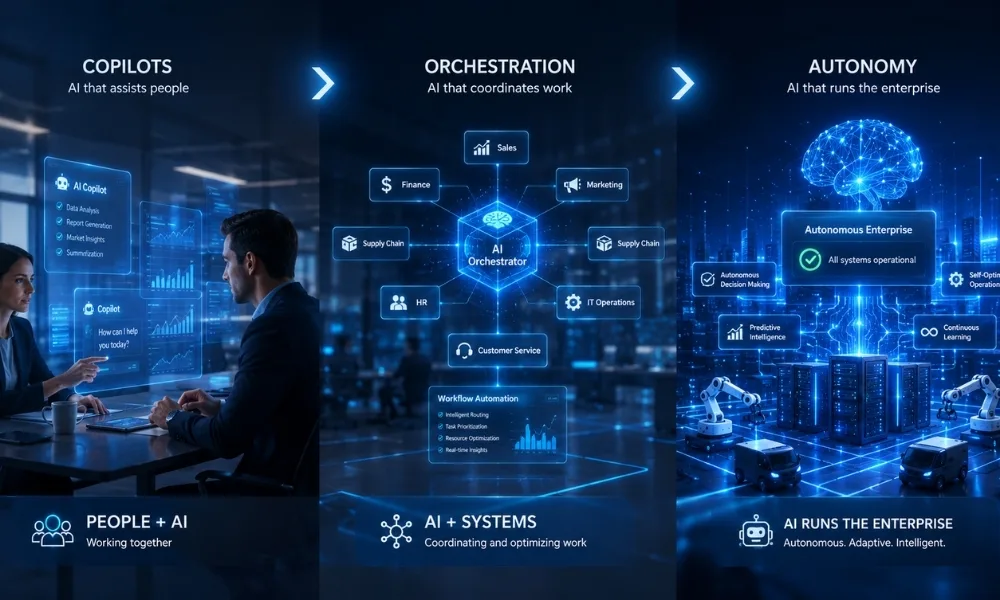
Moving from “chat” to “action” with agentic workflows is the single biggest competitive advantage for 2026. By utilizing multi-agent systems, task orchestration and self-correction loops, you can scale your operations without scaling your overhead.
From Managed IT Services in Las Vegas to Custom Websites & Software Development, IT Works Solutions is ready to build your agentic future. Just as Automatic Data Processing and the market capitalization of Autodesk prove the power of tech-forward thinking, your business can also lead the way. Contact us today to start building your agentic workflows and turn AI potential into real-world results.